
| A New Shell Frontier: Fiji Islands by José Coltro |
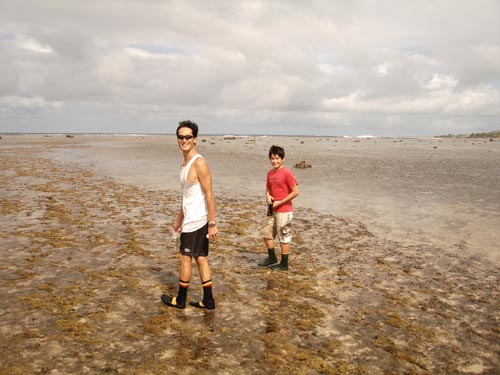
My trip to Fiji started on the night of September 1st. First, I flew to Dallas, a 9½-hour flight; then to Los Angeles, another four hours. After crossing the International Date Line and completely losing Sunday, I spent another 12 hours in the air before finally arriving in Nadi (pronounced “Nanji”), on Viti Levu, on Monday morning, September 4th.
My friend Bernie was waiting for me, and I had no problems at immigration or customs. The 747-400 had been packed with tourists from the United States, Canada, England and Sweden, as well as Fijians returning home.
Bernie drove about 75 km to his home in Korotogo (pronounced “Korotongo”), near Sigatoka (pronounced “Singatoka”), where we arrived at around 7 A.M. I met Bernie’s wife, Suzan, and their children, Cassandra and Titus. After a light breakfast, I was desperate to get out onto the reef, which was only about 50 meters from Bernie’s house. Despite the long journey, I was excited and did not feel tired at all.
The tide was going out as Bernie, Titus and I walked along the edge of the reef. The water temperature was amazing — cold! Not just cold, but VERY COLD! Probably around 17 or 18°C (63°F). As in Brazil, September is the last month of winter, and cold currents sometimes reach the coast. I don’t know whether that had any influence, but we did not find many shells. I hoped we would have better luck snorkeling later in the afternoon.
Shells are very much a part of everyday life in Fiji. Fijians eat many species, including Conus textile and other potentially dangerous cone shells. In fact, they seem to eat almost everything from the sea: sea cucumbers, strange algae, all kinds of crabs and practically anything else that moves! Every morning, women from many coastal villages walk over the reefs collecting shells and other marine animals. Turbinidae are among their favorites, but they collect almost everything they find.
After lunch, Bernie took me into Sigatoka, where we visited the small local market. People there were selling Batissa violacea (Lamarck, 1818), a freshwater bivalve of the family Corbiculidae that is part of the regular Fijian diet. I bought some, but later heard that specimens from the Sigatoka River could contain heavy metals, such as mercury, accumulated in their tissues. Good thing I didn’t try to eat them!
Walking around town, I noticed that roughly half the population was Melanesian Fijian and the other half was of Indian ancestry. The two communities seemed to remain quite separate. I saw very few East Asian or Western people around town, except at hotels and resorts.
That afternoon, I went snorkeling for the first time in Korotogo Bay. Very COLD again! I found only a few species, but the water was so clear that I could have stayed there for hours. Just as I had seen that morning, there were even some Cypraea tigris crawling around in broad daylight.
The next day, we waited for a Fijian named Moala and then went out to the reef, where I showed them the kinds of places in which they should look for shells. They had never paid much attention to some of the smaller or less conspicuous species, and that day we found at least 40 different species. At night, we walked over the reef again and collected several species that we had not seen during the day. It was great.
Over the following days, we visited many places nearby. One particularly memorable trip was to explore the mangroves on the western side of Viti Levu. Our original plan was to go to Nanuya-Sewa, a small island that my friend Tony McCleery had visited two or three times. On the way, however, I saw extensive mangrove areas — much of the western and northern coast of Viti Levu is covered by mangroves. The tide was extremely low and the place looked so promising that I asked Bernie to stop so we could try collecting there.
One very curious thing about Fiji is the procedure required simply to visit a beach. Only a few beaches are freely accessible to visitors; many beaches and reefs are associated with the local villages. To visit one of them, you MUST first ask permission. And it is not simply a matter of arriving, saying hello and asking if you can go collecting. Fijians have elaborate traditional protocols for requesting permission, and for a foreigner it would be almost impossible to do it properly without local help. Thanks to Moala, we were allowed to visit several places where very few Western visitors had ever been.
After obtaining permission, we returned to the mangroves. We began crossing a very difficult area of trees and mud. It took about half an hour to reach the open area, but then I began sinking 30 or 40 centimeters into the mud with every step. When I started sinking even deeper, I became a little concerned.
Moala, Bernie and Titus were having similar problems, but they were about half my weight! After half an hour I was exhausted, and when I stopped to rest, I simply began sinking even more. I was halfway between the trees and the rocks at the edge. What could I do? Bernie was beginning to worry about me, while Moala and Titus were already near the rocks and too far away to help.
I told Bernie, “Don’t laugh, but I’m going to crawl like a fat sea lion.”
So that is exactly what I did. I crawled through the mud and, after a few minutes, finally reached the rocks — where, naturally, I found no shells!
Then the tide began coming in, and I had to make my way back toward the trees. It was disgusting. While crawling and partly swimming through the mud, I saw some floating human waste and discovered that Fijians apparently love corn...
Back among the trees, at least I found some Cerithium, Littorina, Cassidula and a few other shells. By then I was so dirty that we asked the locals for some fresh water so I could wash myself. Unfortunately, I had no spare clothes with me, only my dive skin and my Speedo — a little too aggressive for the local population! I wrapped myself in a beach towel until we reached Lautoka, a medium-sized town on the western coast.
I wanted to visit the market there, and Moala came up with a solution: he bought me a “sulu,” the local sarong. Man, it felt very strange wearing that! I still had my Speedo underneath, but I felt naked most of the time.
On Saturday, we went to Suva to visit the local market. It was very colorful, very crowded, and full of some of the strangest food I had ever seen. When Bernie and I stopped to look at one ugly, spongy-looking thing a woman was selling, she tried to explain what it was. She asked whether we had seen Finding Nemo, and eventually we realized that the strange thing was a sea anemone!
That afternoon, we visited the Fiji Museum. It was fascinating. Did you know that cannibalism was practiced in Fiji until the 19th century? You should see some of the specialized utensils associated with those old practices! The museum also had beautiful traditional handicrafts made from local hardwoods and shells.
Afterwards, we went to Suva Bay and walked along the beach. We found some Nassarius and many different bivalves. On the way back, we stopped at Moala’s village and left him some of the shells I had bought at the market, so that he could eat them and clean the shells for me.
The following week, I planned to do some dredging and take a short cruise through the Yasawa Group. We rented a fishing boat and went to Sovi Bay to dredge. We had no power winch to pull the dredge back up, so Moala and the two fishermen had to do it by hand. It was only a small dredge, but after four or five hauls they were all exhausted! The material I sorted through was very interesting, although there was far too much for me to examine everything carefully.
The Yasawa cruise began on Wednesday morning, and our first stop, at Kese Village, was great. On the beach I found my first freshly dead Nautilus pompilius! I was very excited.
Once again, however, the area where cruise passengers were allowed to snorkel was very limited, and the nicest reef was off-limits to tourists. Again, Moala saved the day, and I was able to do some excellent shelling.
Later, in the village, we watched a performance of traditional dances and customs. It was very interesting. There were handicrafts and shells for sale as well, although the shells were not very good because the villagers cooked them before selling them.
The following morning, we woke up at the Blue Lagoon, a beautiful place surrounded by five islands. One of them, Nanuya Lailai, belonged to the cruise operator, and we had the entire day to snorkel as much as we wanted. The sandy areas were excellent. I found many Terebra, Oliva and Natica. In a grassy area, I found a fabulous Cassis cornuta, but I could not bring myself to take it. It was enormous, and all I could think about was the problem of cleaning it!
We tried snorkeling at night, but only a few minutes after we started, I had problems with my light. I stayed close to Titus, but a few minutes later his light failed too, so that was the end of our night snorkeling.
At dinner, there was some wonderful local singing, and at the end all the guests were asked to sing something in their native language. I was terrified! I had never done anything like that, and the only complete songs I could remember were the ones I used to sing to my daughter Thais when she was a baby!
So I sang one of those.
At least nobody fell asleep!
On the last day, we went to Naukacuvu Island, where I had the best shelling of the entire trip. Unfortunately, I discovered the best spot only about half an hour before we had to leave. I found lots of shells on the rocky reef and became so absorbed in collecting that I missed the dinghy back to the ship.
There was only one solution: swim.
The ship was about one kilometer away, and I discovered that I was still in pretty good shape. In fact, I reached the ship before the dinghy did — and felt great!
On the afternoon of my last day, I packed my luggage for the trip home and had to borrow an extra bag from Bernie. It was completely full of shells and handicrafts.
My journey home began at 6:30 P.M., when I caught a bus from a nearby resort to Nadi Airport. The trip took two hours because the bus stopped at practically every resort and hotel along the way. My flight was scheduled for 10 P.M., and I began worrying that I was going to miss it.
When I finally arrived at the airport, I discovered that the flight had been delayed by an hour and a half!
I had to pay about US$50 for the extra bag. I left Nadi close to midnight on Saturday and arrived in Los Angeles at 3 P.M. — still on Saturday, thanks to the International Date Line.
American immigration and customs were so crowded that it took more than an hour to get through. Then I had to wait until 10 P.M. for my flight to Miami. I finally arrived in Miami at 6:30 Sunday morning.
And guess what happened?
American Airlines had lost my extra bag.
I waited for the next flight from Los Angeles, but the bag was not on it. I spent the entire morning dealing with the airline’s baggage service. They still had not found the bag by the time I wrote this account, and I suspected that when they finally did, they might call the FBI because of the smell of a dead body! There were fresh shells inside that I had collected on Saturday and had not had time to freeze or preserve in alcohol.
I left Miami a few minutes before noon and arrived in São Paulo shortly before 9 P.M. Marcia, my wife, and Thais were waiting for me at the airport. I had missed them a lot.
Aside from the missing bag, it had been a wonderful trip, and I hoped to have some nice shells from Fiji to offer!